
Your search “ ”
Article(s)
Human Rights and the Death Penalty in Iran
on 19 June 2007
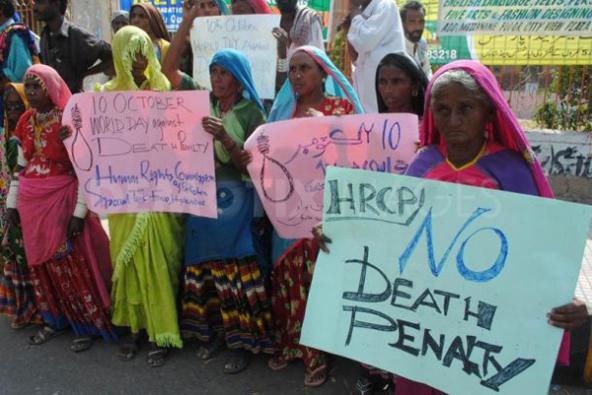
A gathering has taken place in Geneva on June 11, 2007 to protest against human rights violations in Iran. On the initiative of Human Rights in Iran, this demonstration was supported by Hands Off Caïn, the International Committee against Torture, Rights & Democracy, and the Canadian Center for the Victims of Torture (CCVT), among others.
2007
Cruel, Inhuman and Degrading Treatment and Punishment
Iran (Islamic Republic of)
Juveniles
Women
Article(s)
Campaigning for the ratification of the Second Optional Protocol
on 16 June 2007
What if abolitionists were able to begin their next appeal, with a sentence to this effect: “A majority of countries has formally ratified a United Nations treaty permanently banning the death penalty.”
2007
Article(s)
Death sentences in Morocco
on 9 May 2007
The World Coalition against the death penalty, the FIDH and the Moroccan Coalition against the Death Penalty are concerned with the continued pronunciation of death sentences by Moroccan courts
2007
Morocco
Article(s)
Significant but fragile progress in the Great Lakes region
on 1 May 2007
Rwanda and Burundi are apparently close to abolishing the death penalty; in the Democratic Republic of Congo, all references to capital punishment have been removed from the text of the constitution. The death penalty is on borrowed time in these countries scarred by conflicts. For the first time, the region’s abolitionists met in Paris and called for the creation of a regional coalition.
2007
Democratic Republic of the Congo
Public Opinion
Article(s)
The World Coalition plays a pivotal role at the 3rd World Congress Against the Death Penalty
on 1 May 2007
The 3rd World Congress Against the Death Penalty came to an end in Paris on 3 February 2007. It was an opportunity for abolitionists from all around the world to come together in greater numbers than ever to exchange experiences and prospects for the future.
France
Article(s)
Moving towards an inter-Arab coalition against the death penalty
on 1 May 2007
As of today, no country in North Africa and the Middle-East has yet abolished the death penalty. However, there are positive signs that the region is now ready to debate the issue – as can be seen from the profusion of discussions and exchanges that took place during the 3 rd World Congress against the Death Penalty.
Public Opinion
Women
Article(s)
2007 Campaign : developing the world abolitionist movement
on 1 May 2007
The World Coalition Against the Death Penalty has obtained financial support from the European Commission for its 2007 campaign, an indication of its growing recognition and legitimacy.
Article(s)
Take collective action: join the World Coalition
on 1 May 2007
Since 2002 about sixty non-governmental organisations, professional associations and public bodies working throughout the world in support of abolition of the death penalty have come together through the World Coalition Against the Death Penalty.
Document(s)
The lethal injection quandary: how medicine has dismantled the death penalty
By Deborah W. Denno, on 1 January 2007
2007
Article
United States
More details See the document
On February 20, 2006, Michael Morales was hours away from execution in California when two anesthesiologists declined to participate in his lethal injection procedure, thereby halting all state executions. The events brought to the surface the long-running schism between law and medicine, raising the question of whether any beneficial connection between the professions ever existed in the execution context. History shows it seldom did. Decades of botched executions prove it. This Article examines how states ended up with such constitutionally vulnerable lethal injection procedures, suggesting that physician participation in executions, though looked upon with disdain, is more prevalent— and perhaps more necessary —than many would like to believe. The Article also reports the results of this author’s unique nationwide study of lethal injection protocols and medical participation. The study demonstrates that states have continued to produce grossly inadequate protocols that severely restrict sufficient understanding of how executions are performed and heighten the likelihood of unconstitutionality. The analysis emphasizes in particular the utter lack of medical or scientific testing of lethal injection despite the early and continuous involvement of doctors but ongoing detachment of medical societies. Lastly, the Article discusses the legal developments that led up to the current rush of lethal injection lawsuits as well as the strong and rapid reverberations that followed, particularly with respect to medical involvement. This Article concludes with two recommendations. First, much like what occurred in this country when the first state switched to electrocution, there should be a nationwide study of proper lethal injection protocols. An independent commission consisting of a diverse group of qualified individuals, including medical personnel, should conduct a thorough assessment of lethal injection, especially the extent of physician participation. Second, this Article recommends that states take their execution procedures out of hiding. Such visibility would increase public scrutiny, thereby enhancing the likelihood of constitutional executions. By clarifying the standards used for determining what is constitutional in Baze v. Rees, the U.S. Supreme Court can then provide the kind of Eighth Amendment guidance states need to conduct humane lethal injections.
- Document type Article
- Countries list United States
- Themes list Methods of Execution, Lethal Injection,
Document(s)
Crime and Justice. Abolishing the Death Penalty
By IPS, on 1 January 2007
Book
More details See the document
The IPS ‘Death Penalty Abolition Project’, supported bythe European Union, has recorded the voices of many of those who have played a key role in the recently fast-moving journey towards a death-penalty-free world. In doing so, IPS has been guided by the purposes and principles contained in the Charter of the United Nations, the Universal Declaration of Human Rights, theInternational Covenant on Civil and Political Rights and the Convention on the Rights of the Child.Collected here are some 100 reports from dozens ofcountries and every continent. The voices of those who have spoken out here – many hundreds in number – include activists,academics, lawyers and, of course, those waiting for that dreaded last knock on their cell door.
- Document type Book
- Themes list Moratorium , Trend Towards Abolition, Death Penalty,