Making gender discrimination in capital punishment visible

on 6 March 2023

For the World Coalition Against the Death Penalty, the fight for the abolition of the death penalty must be based on an intersectional and gender-based approach. Since 2021, on World Day Against the Death Penalty, dedicated to the invisible reality of women sentenced to death, the World Coalition has been proactively engaged in raising awareness of the intersectional discrimination faced by women and LGBTQ+ people in the judicial process leading to the death penalty. The World Coalition is currently concentrating its efforts on these issues primarily in the following countries: Cameroon, Indonesia, Iran, Japan, Jordan, Kenya, Malaysia, Nigeria, Saudi Arabia, Sri Lanka, Tanzania, Thailand, Uganda, and the United States.This work is made possible thanks to the support of Global Affairs Canada through a project implemented from 2022 to 2026, and of the French Development Agency through projects implemented during the 2024–2027 period.

  • Understanding the link between gender discrimination and the death penalty

    Women and the death penalty

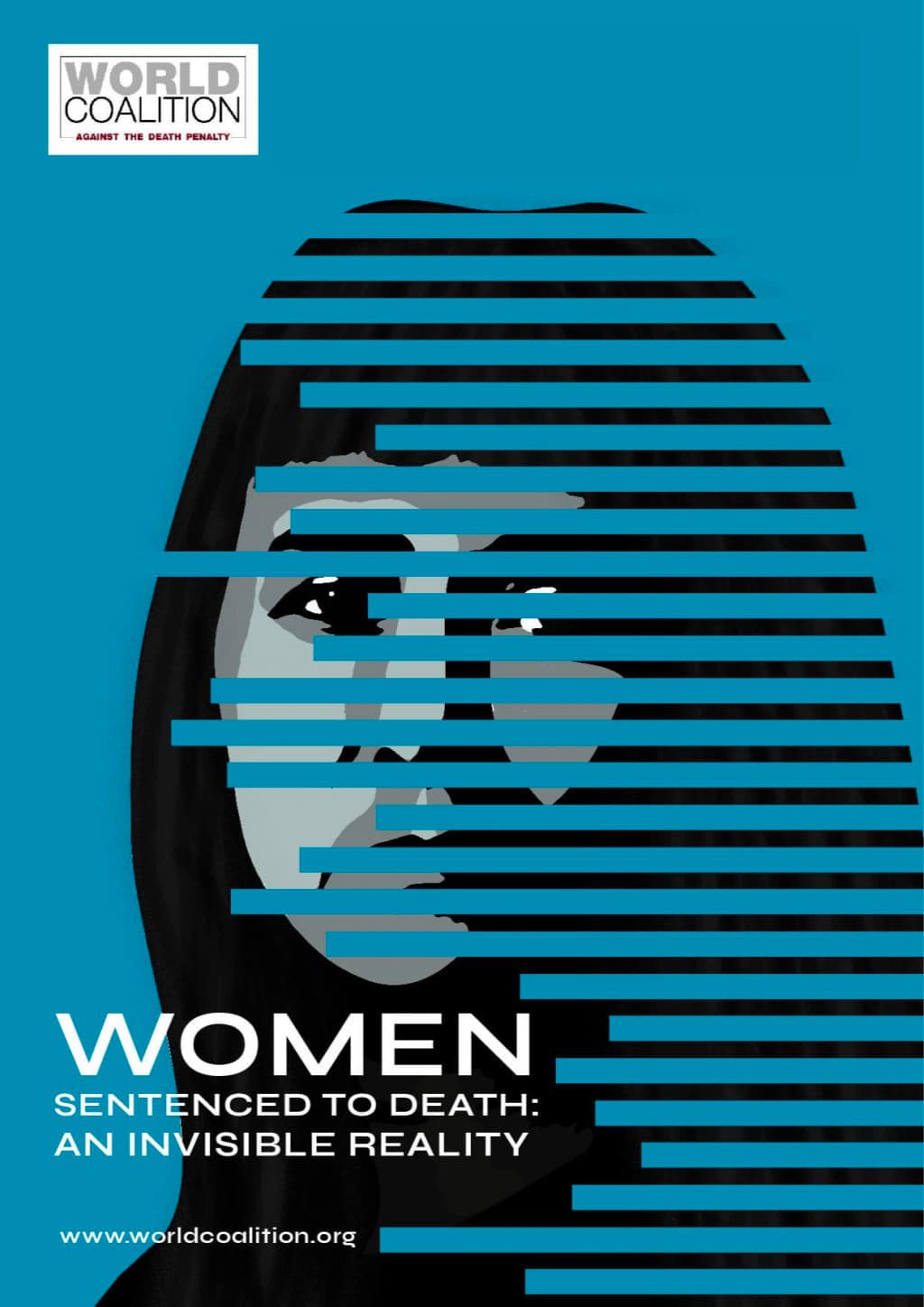
    Although women currently make up less than 5% of the global death row population, analysis of their profiles, backgrounds, and crimes for which they were sentenced to death deserves particular attention as it reveals the significant existence of gender biases in capital punishment proceedings. Women are exposed to intersectional discrimination throughout the judicial process leading to the death penalty as well as once on death row.

    The 2018 Cornell Center on the Death Penalty Worldwide report, the first comprehensive report on the subject, shows that a large majority of women on death row are from ethnic and racial minorities, non-literate, have intellectual, mental and/or psychosocial disabilities, and have experienced gender-based violence. In some regions, such as the Gulf States and Southeast Asia, most women on death row are migrant. The weight of gender discrimination is also reflected in the judicial process. Gender bias is present at the investigation stage, where law enforcement agencies display gender bias; at the trial stage, where many women do not have access to a fair trial due to lack of economic resources; and at the sentencing stage, where gender-related antecedents and circumstances of the crime, such as a history of gender-based violence, are not considered. Once in prison, women’s gender-specific needs, including sexual and reproductive health, medical and mental health care, protection from gender-based and sexual violence, and substance use harm reduction services, are not addressed.

    « A human rights-based approach to capital punishment cannot be complete without a gender component » Agnès Callamard, UN Special Rapporteur on extrajudicial, summary or arbitrary executions, 2018
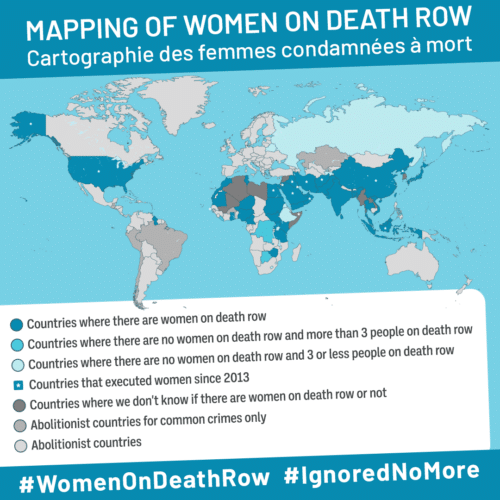
    Mapping of women on death row

    Gender and sexual minorities and the death penalty

    LGBTQIA+ individuals1 are also exposed to discrimination in the application of the death penalty. Sexual minorities are first directly stigmatized by criminal laws. 11 states worldwide (Afghanistan, Saudi Arabia, United Arab Emirates, Iran, Mauritania, Qatar, Nigeria, Pakistan, Somalia, Yemen, and Brunei) apply the death penalty for consensual same-sex sexual activity. In many countries, other morality-based offenses, such as « cross-dressing » and « offenses against public morals » are grounds for criminal prosecution that can lead to death sentences. Once on death row, gender and sexual minorities are particularly vulnerable to abuse and mistreatment.

    The World Coalition believes in the importance of a gender analysis of capital punishment to raise awareness of the inhumane and discriminatory nature of the death penalty and to advocate for its total abolition.

    1 The World Coalition Against the Death Penalty chooses to use the acronym LGBTIQIA+ in order to use the most comprehensive and inclusive “umbrella” term. It is important to note that these terms and acronyms are neither universally accepted nor uniformly used.

  • Gender and the Death Penalty at the World Coalition

    The integration of a gender-based perspective on the death penalty is one of the commitments of the World Coalition Against the Death Penalty. Together with its members, it implements actions aimed at strengthening the protection of women and LGBTQ+ people facing the death penalty and, more broadly, works to highlight intersectional gender discrimination in the capital punishment process.

    The World Coalition is currently focusing its “gender and the death penalty” actions in the following countries: Cameroon, Indonesia, Iran, Japan, Jordan, Kenya, Malaysia, Nigeria, Saudi Arabia, Sri Lanka, Tanzania, Thailand, Uganda, and the United States.

    Strengthen the capacity of civil society organizations

    The World Coalition Against the Death Penalty assists its members to strengthen their knowledge and skills to incorporate a gender-based approach in their abolitionist actions.
    This support is done through the following actions:

    • coordination of a Gender Working Group, composed of all World Coalition member organizations with an interest or expertise in gender;
    • managing a mailing list for all partner organizations in the 14 target countries to share opportunities for collaboration and relevant information;
    • developing and facilitating training and practical tools on the integration of gender issues in the abolitionist struggle;
    • capitalizing on and sharing good practices on how to develop a gender-based abolitionist strategy;
    • accompanying members in a gender-sensitive mobilization for the World Day Against the Death Penalty.

    Strengthen links with women’s, gender and sexual minority rights movements and organizations

    The World Coalition Against the Death Penalty believes it is important to strengthen the abolitionist movement’s ties with women’s rights and gender and sexual minority organizations. To this end, the World Coalition invites these organizations to join the abolitionist movement and to collaborate in the development of joint events and tools.

    Strengthen the knowledge of UN member states and abolitionist human rights organizations to advocate for a gender-sensitive approach to abolishing the death penalty.

    The World Coalition Against the Death Penalty supports the coordination of gender-sensitive international abolitionist advocacy. Particular attention is paid to the systematic integration of gender issues in the advocacy carried out with all human rights mechanisms as well as in the implementation of specific advocacy with specialized mechanisms on women’s rights such as the Committee on the Elimination of Discrimination against Women.

Suscribe to our new quartely newsletter on gender & the death penalty
Related document(s)

Document(s)

Judged for More than Her Crime: a Global Overview of Women Facing the Death Penalty

By Cornwell Death Penalty Project / Delphine Lourtau, on 1 January 2018


2018

NGO report

fr
More details See the document

This groundbreaking report aims to bridge critical gaps in understanding of how states apply capital punishment from a gender perspective. This study is the first to examine how and when women receive death sentences and the conditions under which they are detained on death row, with a particular focus on India, Indonesia, Jordan, Malawi, Pakistan and the United States. The conclusions are that gender discrimination is pervasive at all stages of capital cases, but that its operation is complex. Report published by Cornell Center on the Death Penalty Worldwide with the support of the World Coalition Against the Death Penalty

Document(s)

Detailed Factsheet: Women and the Death Penalty

By World Coalition Against the Death Penalty, The Advocates for Human Rights, on 1 July 2021


2021

Campaigning

Women

fr
More details Download [ pdf - 534 Ko ]

On 10 October 2021, the World Coalition Against the Death Penalty and other abolitionist organizations worldwide will celebrate the 19th World Day Against the Death Penalty.

This year, the World Day is dedicated to women who risk being sentenced to death, who have received a death sentence, who have been executed, and to those who have had their death sentences commuted, exonerated, or pardoned.

This detailed factsheet will use the phrase “women sentenced to death” as an inclusive phrase for all of these categories. As women represent a small percentage of those on death row globally, very little has been reported about these women. Yet we can learn much by analyzing their crimes, their lives prior to the crimes, and the conditions under which they are detained on death row.

Document(s)

State-Sanctioned Killing of Sexual Minorities: Looking Beyond the Death Penalty

By Mai Sato, Christopher Alexander - Eleos Justice and Capital Punishment Justice Project, Monash University, on 10 August 2021


2021

Academic report

Australia

Cruel, Inhuman and Degrading Treatment and Punishment


More details See the document

This report examines the extent to which states sanction the killing of sexual minorities. It looks beyond those countries that impose the death penalty for same-sex intimacy to the far greater number of countries in which state actors commission, condone, endorse and enable such killings.
He argues that the state-sanctioned killing of sexual minorities is often perpetrated well beyond the boundaries of the law, and even in countries that do not criminalise such conduct.

  • Document type Academic report
  • Countries list Australia
  • Themes list Cruel, Inhuman and Degrading Treatment and Punishment

Document(s)

Defending Women and Transgender Persons Facing Extreme Sentences: A Practical Guide

on 14 January 2022


2022

Legal Representation

Legal Representation

Women

fr
More details See the document

Written by a team including experts in the fields of capital defense, gender rights, gender-sensitive mitigation and the rights of transgender persons, the guide includes sections on gender-based violence, women’s mental health, prison conditions, discrimination in the legal system, working with the media, and how to build a gender-sensitive team. It also includes a step-by-step gender-sensitive interview protocol that builds on resources developed by the anti-violence community and is tailored to the needs of defense teams.

Document(s)

“No One Believed Me”: A Global Overview of Women Facing the Death Penalty for Drug Offenses

on 5 October 2021


2021

NGO report

Drug Offenses

Women

fr
More details See the document

“No one believed me” is a quote from Merri Utami, who was sentenced to death for drug trafficking in Indonesia in 2002. Her quote reflects the injustices faced by women accused of capital drug offenses around the world: many decision-makers disbelieve women’s plausible innocence claims or discount the effects of relationships and economic instability on women’s decisions to traffic drugs.

  • Document type NGO report
  • Themes list Drug Offenses / Women
  • Available languages

Document(s)

Leaflet Women and the Death Penalty

By World coalition against the death penalty, on 2 October 2023


2023

World Coalition

Gender

fr
More details Download [ pdf - 1448 Ko ]

Document(s)

Leaflet LGBTQIA+ people and the Death Penalty

By World coalition against the death penalty, on 2 October 2023


World Coalition

Gender

fr
More details Download [ pdf - 861 Ko ]

Document(s)

Women and the Death Penalty in Iran: A Gendered Perspective

By Iran Human Rights (IHRNGO), on 6 January 2025


2025

NGO report

Death Row Conditions

Gender

Iran (Islamic Republic of)

Women


More details See the document

This comprehensive report by Iran Human Rights (IHRNGO) explores the gendered dimensions of the death penalty in Iran, highlighting systemic inequalities, discriminatory laws, and societal factors that disproportionately affect women on death row. Between 2010 and 2024, at least 241 women were executed, with only 26% of cases officially reported. Many were sentenced under circumstances marked by domestic violence, coerced confessions, or lack of legal representation. The report underscores the urgent need for international advocacy to address these injustices and promote gender equality in Iran’s judicial system.

  • Document type NGO report
  • Countries list Iran (Islamic Republic of)
  • Themes list Death Row Conditions / Gender / Women

Document(s)

Women and The Death Penalty in Kenya: Essays on the Gendered Perspective of the Death Penalty

on 2 February 2024


2024

NGO report

Death Row Conditions

Fair Trial

Gender

Kenya

Women


More details See the document

This publication seeks to make visible the gender and intersectional discrimination faced by women in the judicial process leading to the death penalty. Through the various articlesin this publication, the authors bring to light the reality of women facing the death penalty through a different lens.

The first author, Shekinah Bright Kiting’a, in making a compelling case for abolition of the death penalty, explores how the death penalty uniquely affects women in the context of motherhood. Further, she highlights the rights and well-being of the children affected by their mothers’ death sentences, revealing flaws in our legal and ethical systems. With the overall aim of advocating for its abolition due to its significant impact on both parenthood and children’s rights, her article seeks to push for reforms that honour motherhood and prioritize children’s well-being in these difficult circumstances.

Kenaya Komba dissects gender disparity in the judicial system by exploring the intersection of domestic violence and the death penalty. In making a case for a restorative approach to justice, her article analyses the impact of capital punishment on victims of domestic violence and the systemic injustice and biases they continue to grapple with. Her elaborate analysis of the Constitution of Kenya, 2010 and the Protection Against Domestic Violence Act, 2016, highlights the urgent need for reform in the legal system.

While Analyzing the role the media plays in shaping perceptions of women on death row, Patricia Chepkirui evaluates the implications of positive and negative media portrayals of such women by highlighting the ethical responsibilities of media in the coverage of women on death row cases. The article ultimately underscores the significance of responsiblemedia coverage in ensuring that media exposure of cases of women on death row is fair,balanced, and respectful of their rights and dignity.

Alex Tamei delves into the intricacies of abuse, gender-based violence, and trauma as mitigating factors in death penalty sentencing for women. His article comparatively analyses two Kenyan cases of murder in retaliation to intimate partner violence, seeking to shed light on the plight of victims of gender-based violence. The article effortlessly brings out the nexus between the death penalty and intimate partner violence and makessolid recommendations for change.

The fifth author, Patience Chepchirchir, delves into the nexus between psychological abuse and provocation. Through her article, she brings out the scope of psychological abuse while focusing on the linkage between emotional abuse and provocation and how the same can be considered as mitigating factors. Through an elaborate analysis of case law, she makes a case for psychological abuse of women as a mitigating circumstance during sentencing.

Stella Cherono’s article reflects on the intersectional discrimination faced by women in the criminal trial process leading to death row. The article highlights the complex and overlapping forms of discrimination women experience during the pretrial, trial and sentencing stages. Through her comprehensive analysis of gendered pathways to offending and imprisonment, she challenges how society perceives discrimination.

Loraine Koskei Interrogates the emerging jurisprudence on Intimate Partner Violence.Her article lays out the gendered factor in the commissioning and sentencing of women convicted of murder and offers possible recommendations.

  • Document type NGO report
  • Countries list Kenya
  • Themes list Death Row Conditions / Fair Trial / Gender / Women

Document(s)

Women Facing the Death Penalty in Saudi Arabia: Invisibility and Structural Injustice

By ALQST, on 12 March 2026


2026

NGO report

Gender

Saudi Arabia

Women


More details See the document
  • Document type NGO report
  • Countries list Saudi Arabia
  • Themes list Gender / Women

Document(s)

Beyond Her Sentence – A Technical Analysis of Gender and Capital Punishment in Nigeria

By Hope Behind Bars Africa, on 11 September 2026


2026

NGO report

Nigeria

Women


More details See the document
  • Document type NGO report
  • Countries list Nigeria
  • Themes list Women

Document(s)

Criminal Justice and Gender: An In-depth Analysis of the Situation of Women Sentenced to Death in Jordan 2025

By Adaleh Center for Human Rights Studies, on 11 September 2026


NGO report

Jordan

Women


More details Download [ pdf - 498 Ko ]
  • Document type NGO report
  • Countries list Jordan
  • Themes list Women

Document(s)

Accumulated suffering under relational punishment: a portrait of the lives of six women on death row and their families – LBHM

By LBH Masyarakat (Community Legal Aid Institute), on 7 May 2026


2026

NGO report

Gender

Women


More details See the document
  • Document type NGO report
  • Themes list Gender / Women

Document(s)

Gender And Death Penalty Project – Narrative Project Report

By World Coalition Against the Death Penalty , on 11 September 2026


2026

NGO report

United Republic of Tanzania

Women


More details Download [ pdf - 2580 Ko ]
  • Document type NGO report
  • Countries list United Republic of Tanzania
  • Themes list Women