
Your search “ ”
Article(s)
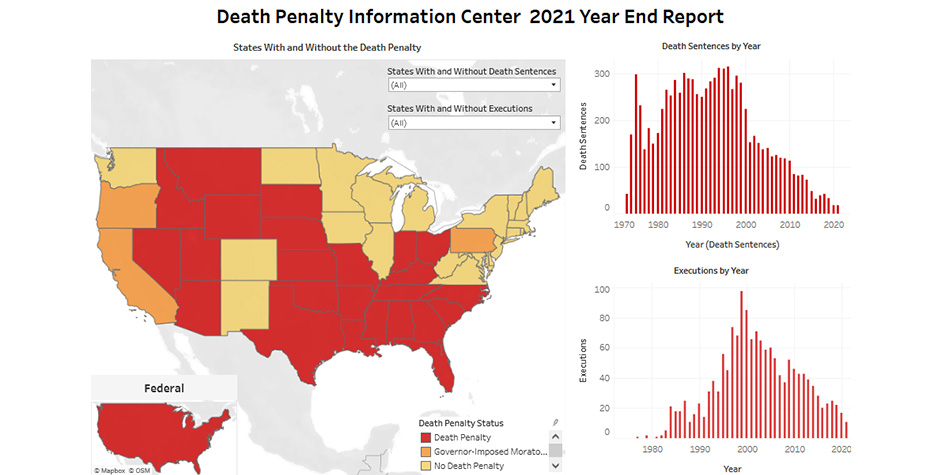
Executions and Death Sentences Near Record Lows in 2021 in the USA
By Death Penalty Information Center, on 13 January 2022
Virginia’s historic abolition of the death penalty highlighted a year in which public opinion polls, executions, and new death sentences all signaled continued erosion of support for capital punishment across the United States.
2022
Public Opinion
United States
Document(s)
Uganda – Committee on the Elimination of Discrimination Against Women – Death Penalty – January 2022
on 12 January 2022
2022
NGO report
World Coalition
Uganda
Women
More details Download [ pdf - 243 Ko ]
This report addresses Uganda’s compliance with its obligations under the Convention on the Elimination of All Forms of Discrimination Against Women with respect to the death penalty. The report examines and discusses Ugandan death penalty laws and cases where women are sentenced to death row in Uganda, primarily for murder.
This report recommends that Uganda adopt a number of key recommendations to better align its death penalty practices with Uganda’s obligations to women under the Convention. These steps, among other things, include: (1) abolishing the death penalty and in the interim, limiting the death penalty to only the most serious crimes of intentional killing of another human; (2) ensuring proper gender-sensitive training in the judicial system and protecting women in conflict with the law when gender-based violence is involved; (3) developing and implementing programs to prevent gender-based violence and discrimination; and (4) ensuring fair access to counsel to women sentenced to death or at risk of being sentenced to death.
- Document type NGO report / World Coalition
- Countries list Uganda
- Themes list Women
Document(s)
Lebanon – Committee on the Elimination of Discrimination Against Women – Death Penalty
on 12 January 2022
NGO report
World Coalition
Lebanon
Women
More details Download [ pdf - 1599 Ko ]
This report addresses Lebanon’s compliance with human rights obligations under the Convention on the Elimination of All Forms of Discrimination Against Women regarding its use of the death penalty.
Lebanon has not abolished the death penalty or established a de jure moratorium on the death penalty. The legal system does not protect women in conflict with the law from discrimination on the basis of sex or gender. Nor does it limit capital offenses to the “most serious” crimes.
Women migrant domestic workers appear to be at an elevated risk of being sentenced to death. Indeed, all three women known to be on death row in Lebanon are Sri Lankan migrant domestic workers. Such women face heightened obstacles to realizing their right to a fair trial. Moreover, there is no evidence that sentencing authorities take into account a woman’s history of abuse when determining an appropriate sentence. Finally, women under sentence of death face degrading conditions of detention.
- Document type NGO report / World Coalition
- Countries list Lebanon
- Themes list Women
Document(s)
No death penalty: Essay on the human dignity of the guilty
By Alfredo De Francesco , on 11 January 2022
2022
Book
More details See the document
Is the death penalty “natural” or sometimes legally due?
If not, is the death penalty always a political instrument?
If so, how and why can it be said that the death penalty is unjust, also considering religious values?
What about in case of war time or of very dangerous criminals?
In which way can there be an irrefutable argument for banning the death penalty worldwide and forever?
These and other issues concerning the death penalty are addressed by the Author of this book.
A book, where the most common theories for and against the death penalty are considered in the light of law history and philosophical views, and where Cesare Beccaria’s approach is revised, taking into account the development of the contemporary criminal law and of the legal positivism.
This is an essay, where the protection of humanity is not considered simply as a hope or as a naive dream, but rather as a juridical concept, absolutely necessary to understand one of most tragic questions of all time: “is it just to kill those who killed?”
- Document type Book
Member(s)
Americans for Democracy and Human Rights in Bahrain
on 7 January 2022
Americans for Democracy & Human Rights in Bahrain (ADHRB) fosters awareness of and support for democracy and human rights in Bahrain and Gulf Cooperation Council Countries (GCC). ADHRB has launched an Anti-Death Penalty Campaign during the summer of 2020 which involved local, national, and international engagements to advocate and lobby for the abolition of the […]
2022
Bahrain
Article(s)
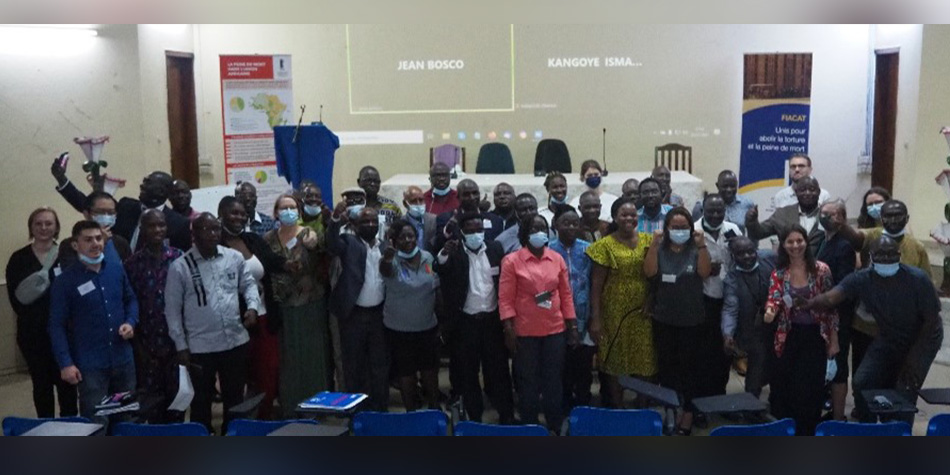
Capitalization workshop of the project for the abolition of the death penalty in sub-Saharan Africa
By Elise Garel, on 4 January 2022
Member organizations of the World Coalition Against the Death Penalty and African ACATs (Action des Chrétiens pour l’Abolition de la Torture) met in Abidjan (Côte d’Ivoire) for the capitalization workshop of Phase 2 of the project for the abolition of the death penalty in sub-Saharan Africa, organized on 29 and 30 November by the World […]
2022
Côte d'Ivoire
Moratorium
Public Opinion

Article(s)
Protest Against Executions Ordered by Minister of Justice Yoshihisa Furukawa
By Center for Prisoner Rights and Japan Innocence and Death Penalty Information Center, on 23 December 2021
On 21 December 2021, Japan’s new governement executed three men after two years with no execution during which Japan hosted the Olympics and the United Nations Congress on Criminal Justice.
2021
Japan
Legal Representation
Moratorium
Document(s)
Sri Lankan expert needed to conduct study on the death penalty – Terms of reference
By World Coalition Against the Death Penalty, on 23 December 2021
World Coalition
More details Download [ pdf - 83 Ko ]
- Document type World Coalition
Article(s)
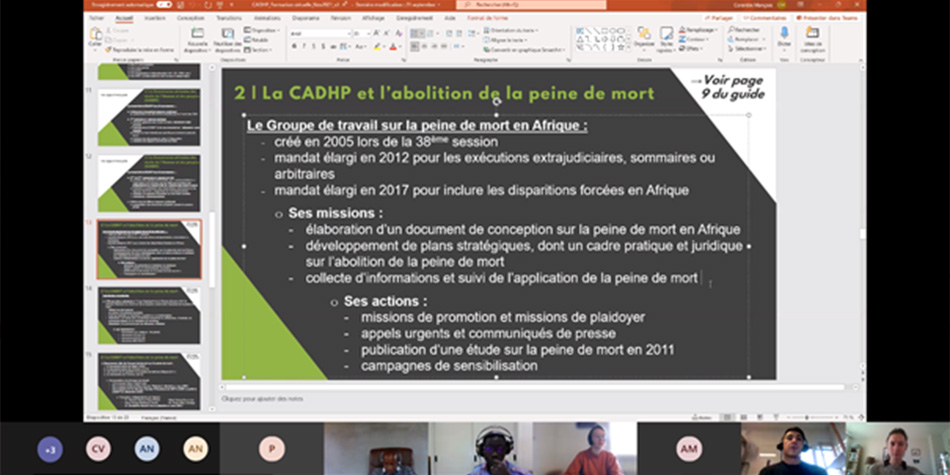
NGO Forum and 69th Ordinary Session of the African Commission of Human and Peoples’ Rights
By Bronwyn Dudley and Corentin Mançois, on 17 December 2021
The ACHPR (the African Commission on Human and Peoples’ Rights) met again virtually for its 69th Ordinary Session from 15 November – 5 December 2021.
2021
Terrorism
Women
Document(s)
Children who are Impacted by a Family Member’s Death Sentence or Execution: Information for Mental Health Professionals
By National Child Traumatic Stress Network (NCTSN), Texas after violence project, Clinical and Support Options, on 11 December 2021
2021
Working with...
Juveniles
More details See the document
This tip sheet provides some guidelines for mental health professionals who may encounter or work with children and families related to individuals who have been sentenced to death or executed.
- Document type Working with...
- Themes list Juveniles